Sustainable and Ethical Sourcing Practices and Their Challenges in the Bangladeshi RMG IndustryFinal defense · Md. Sohel Rana · Roll 251110214 · PGD-GB Batch 11, IBA, University of Dhaka
← Back PDF Download PPTX
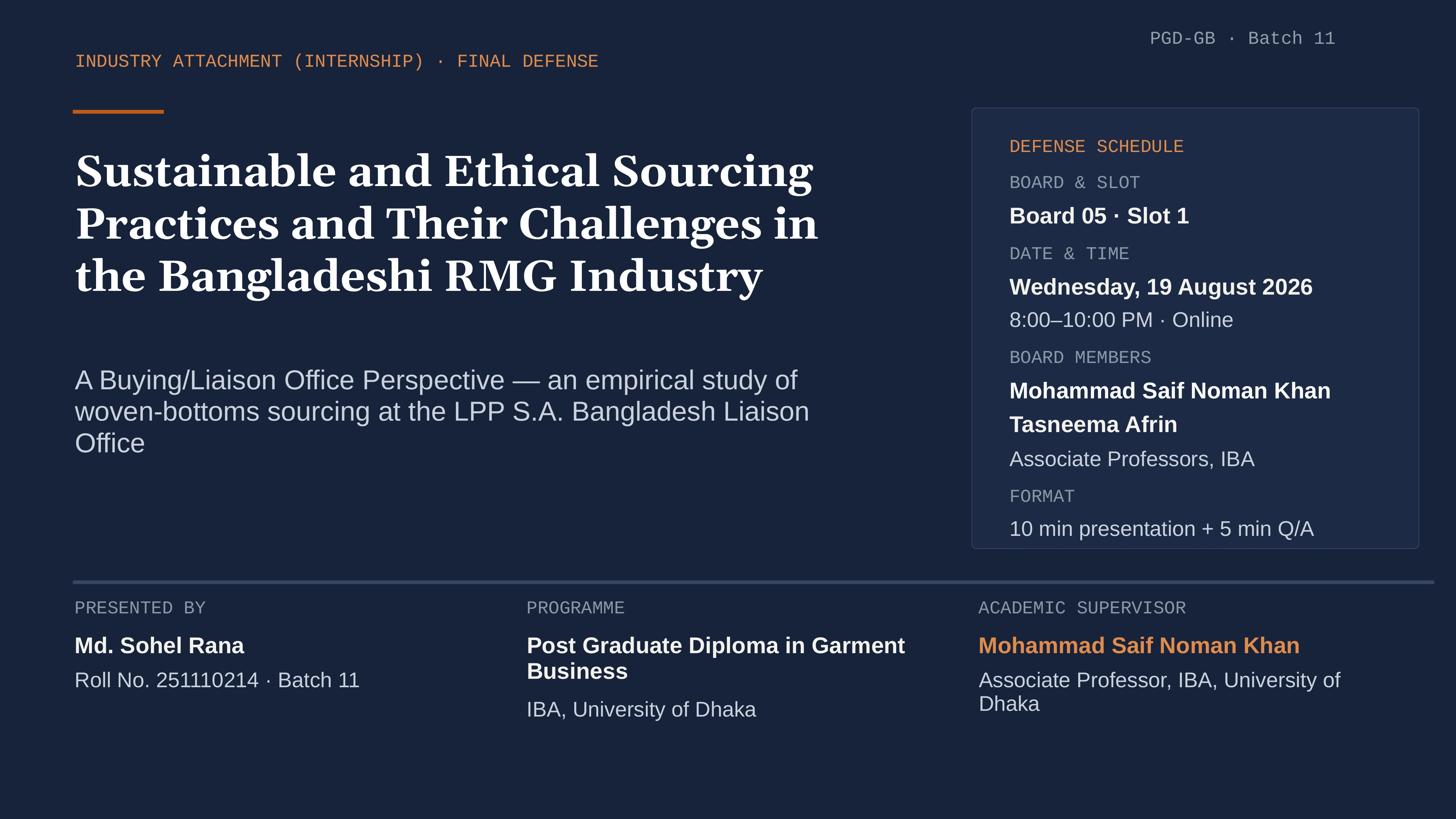
Slide 1 of 12: PGD-GB · Batch 11 INDUSTRY ATTACHMENT (INTERNSHIP) · FINAL DEFENSE DEFENSE SCHEDULE Sustainable and Ethical Sourcing Practices and Their Challenges in the Bangladeshi RMG Industry BOARD & SLOT Board 05 · Slot 1 DATE & TIME Wednesday, 19 August 2026 8:00–10:00 PM · Online BOARD MEMBERS A Buying/Liaison Office Perspective — an empirical study of woven-bottoms sourcing at the LPP S.A. Bangladesh Liaison Office Mohammad Saif Noman Khan Tasneema Afrin Associate Professors, IBA FORMAT 10 min presentation + 5 min Q/A PRESENTED BY PROGRAMME ACADEMIC SUPERVISOR Md. Sohel Rana Post Graduate Diploma in Garment Business Mohammad Saif Noman Khan Roll No. 251110214 · Batch 11 Associate Professor, IBA, University of Dhaka IBA, University of Dhaka
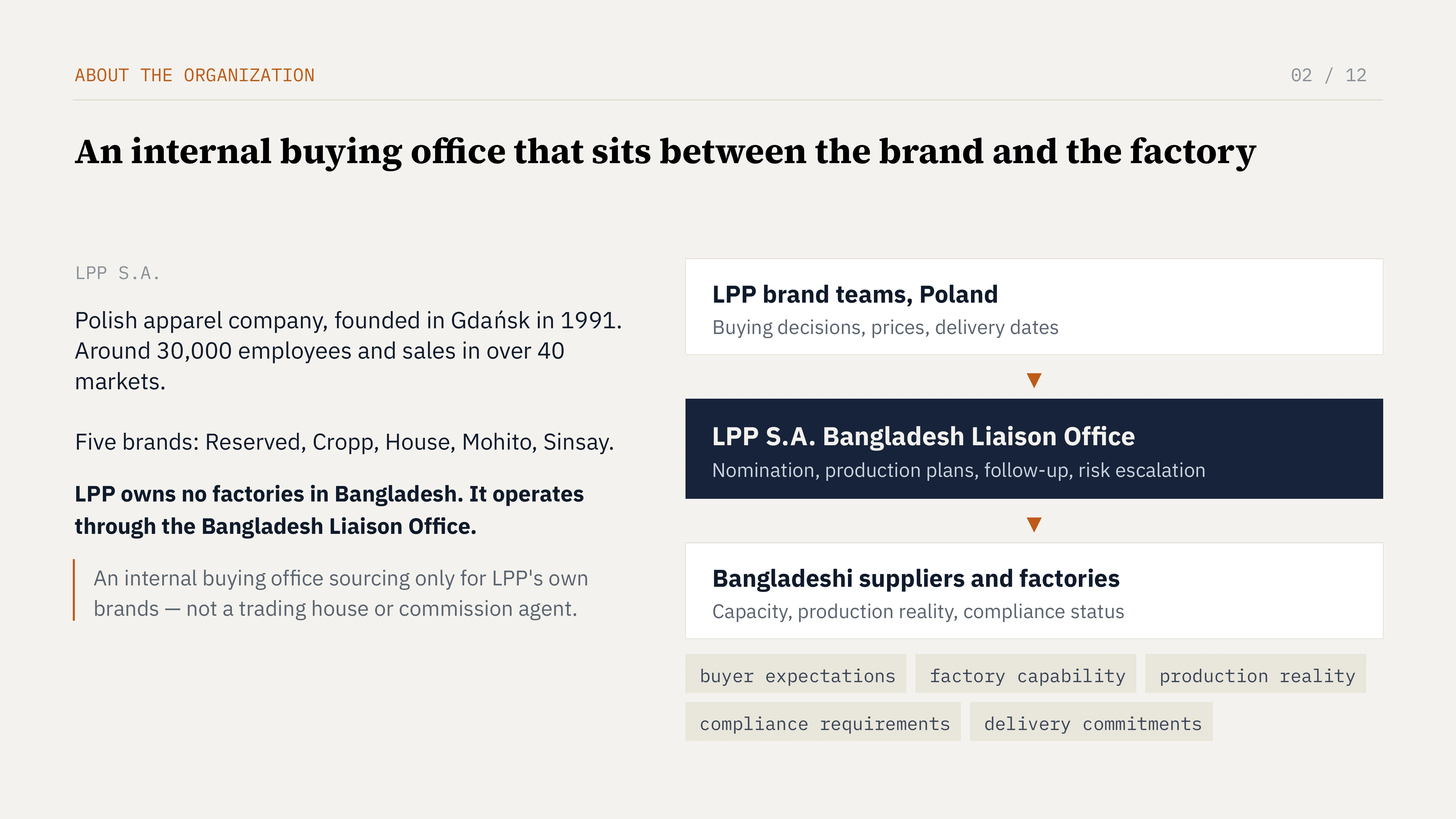
Slide 2 of 12: ABOUT THE ORGANIZATION 02 / 12 An internal buying office that sits between the brand and the factory LPP S.A. LPP brand teams, Poland Polish apparel company, founded in Gdańsk in 1991. Around 30,000 employees and sales in over 40 markets. Buying decisions, prices, delivery dates LPP S.A. Bangladesh Liaison Office Five brands: Reserved, Cropp, House, Mohito, Sinsay. Nomination, production plans, follow-up, risk escalation LPP owns no factories in Bangladesh. It operates through the Bangladesh Liaison Office. An internal buying office sourcing only for LPP's own brands — not a trading house or commission agent. Bangladeshi suppliers and factories Capacity, production reality, compliance status buyer expectations factory capability production reality compliance requirements delivery commitments
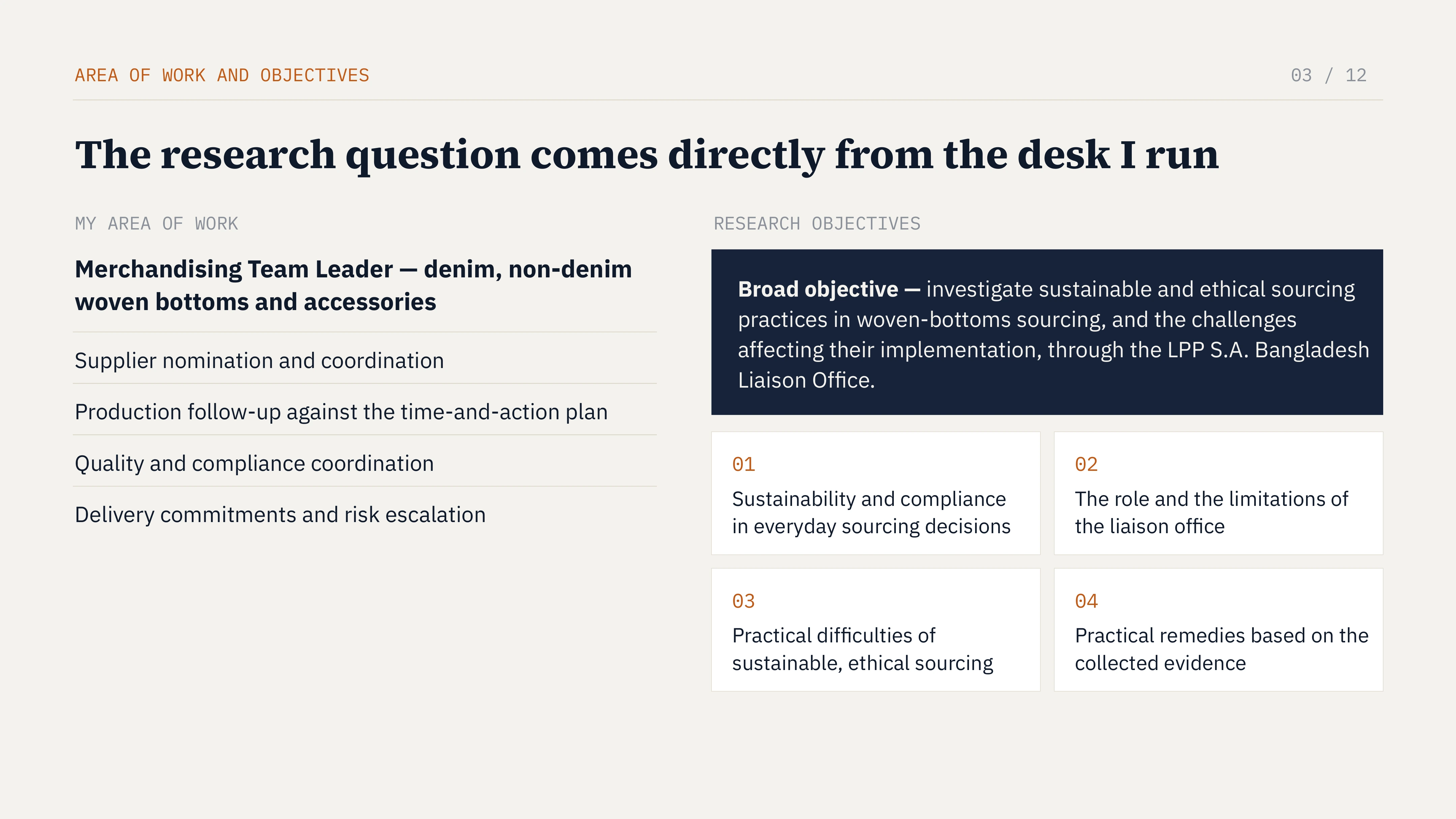
Slide 3 of 12: AREA OF WORK AND OBJECTIVES 03 / 12 The research question comes directly from the desk I run MY AREA OF WORK RESEARCH OBJECTIVES Merchandising Team Leader — denim, non-denim woven bottoms and accessories Broad objective — investigate sustainable and ethical sourcing practices in woven-bottoms sourcing, and the challenges affecting their implementation, through the LPP S.A. Bangladesh Liaison Office. Supplier nomination and coordination Production follow-up against the time-and-action plan Quality and compliance coordination 01 02 Sustainability and compliance in everyday sourcing decisions The role and the limitations of the liaison office Delivery commitments and risk escalation 03 04 Practical difficulties of sustainable, ethical sourcing Practical remedies based on the collected evidence
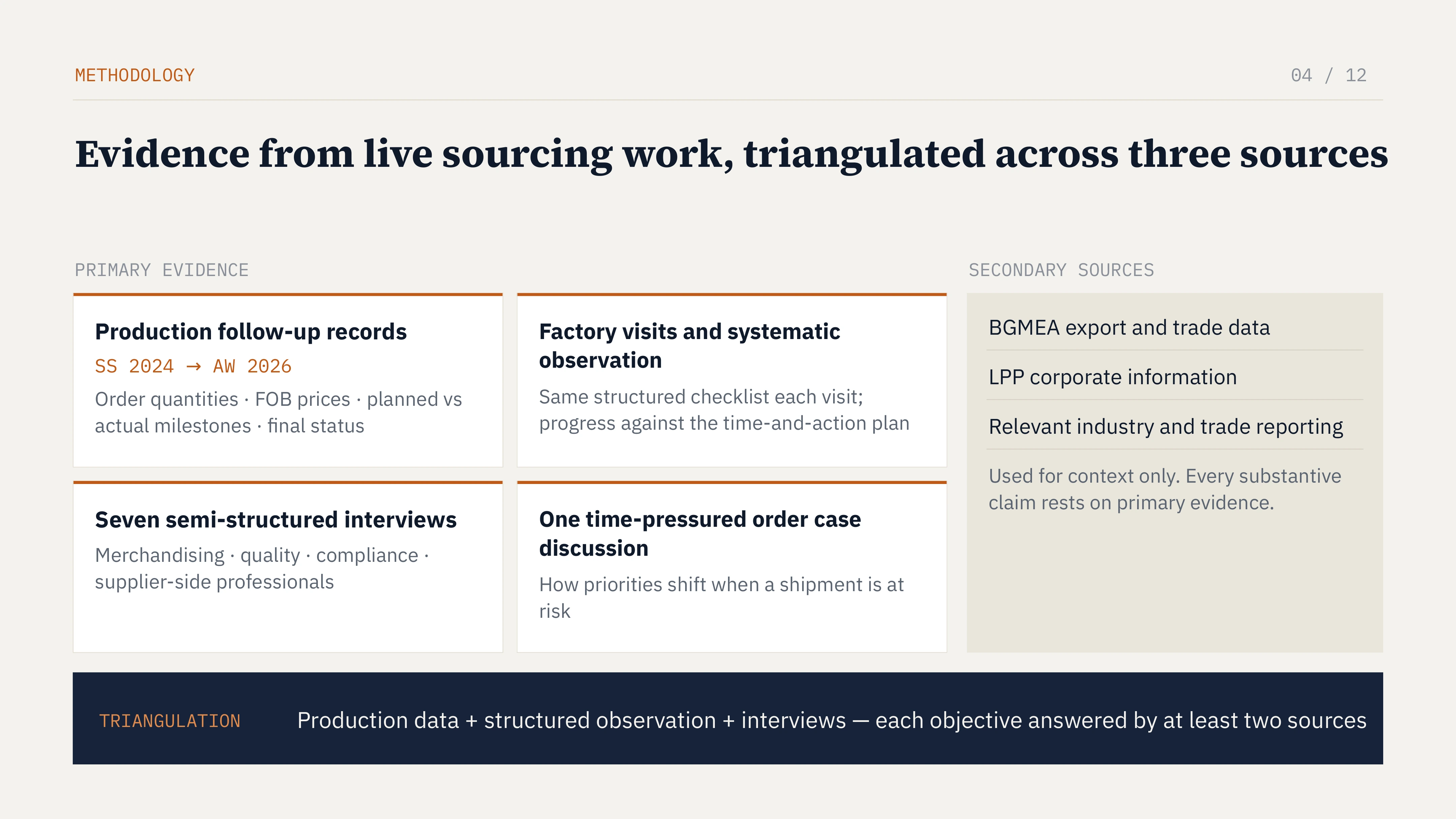
Slide 4 of 12: METHODOLOGY 04 / 12 Evidence from live sourcing work, triangulated across three sources PRIMARY EVIDENCE SECONDARY SOURCES BGMEA export and trade data Production follow-up records Factory visits and systematic observation SS 2024 → AW 2026 LPP corporate information Same structured checklist each visit; progress against the time-and-action plan Order quantities · FOB prices · planned vs actual milestones · final status Relevant industry and trade reporting Used for context only. Every substantive claim rests on primary evidence. Seven semi-structured interviews One time-pressured order case discussion Merchandising · quality · compliance · supplier-side professionals How priorities shift when a shipment is at risk Production data + structured observation + interviews — each objective answered by at least two sources TRIANGULATION
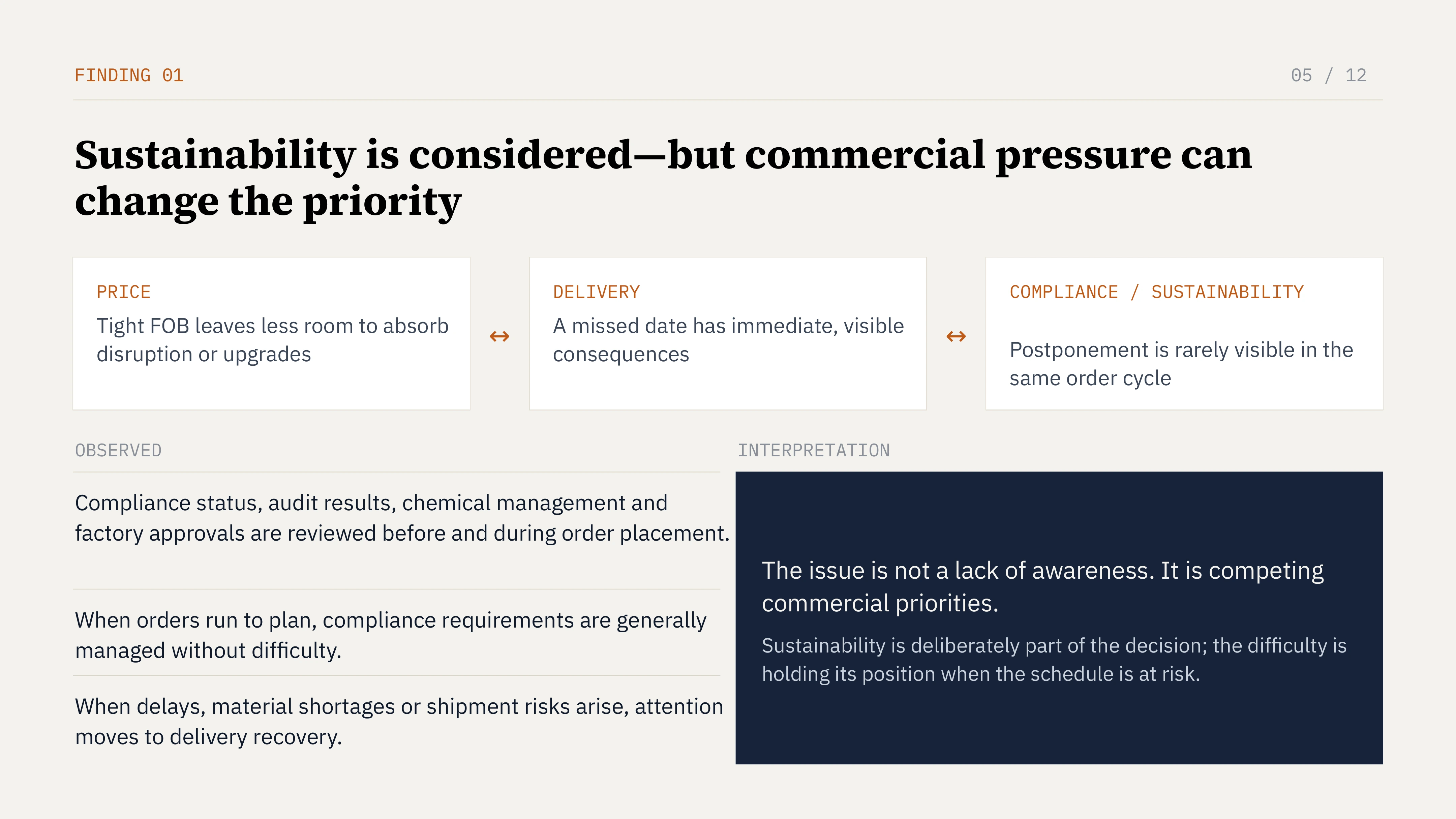
Slide 5 of 12: FINDING 01 05 / 12 Sustainability is considered—but commercial pressure can change the priority PRICE DELIVERY COMPLIANCE / SUSTAINABILITY Tight FOB leaves less room to absorb disruption or upgrades A missed date has immediate, visible consequences Postponement is rarely visible in the same order cycle OBSERVED INTERPRETATION Compliance status, audit results, chemical management and factory approvals are reviewed before and during order placement. The issue is not a lack of awareness. It is competing commercial priorities. When orders run to plan, compliance requirements are generally managed without difficulty. Sustainability is deliberately part of the decision; the difficulty is holding its position when the schedule is at risk. When delays, material shortages or shipment risks arise, attention moves to delivery recovery.
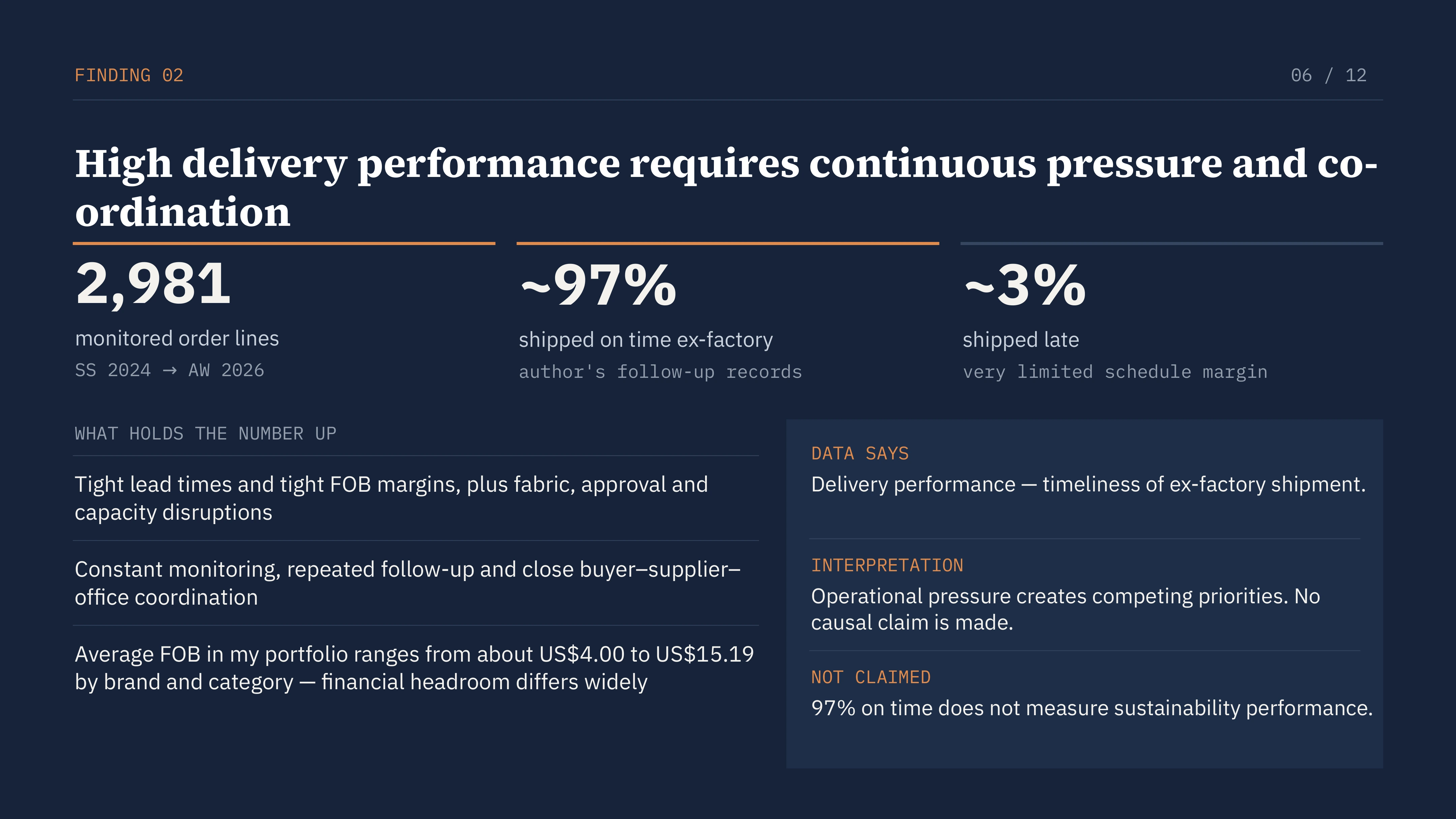
Slide 6 of 12: FINDING 02 06 / 12 High delivery performance requires continuous pressure and co-ordination 2,981 ~97% ~3% monitored order lines shipped on time ex-factory shipped late SS 2024 → AW 2026 author's follow-up records very limited schedule margin WHAT HOLDS THE NUMBER UP DATA SAYS Tight lead times and tight FOB margins, plus fabric, approval and capacity disruptions Delivery performance — timeliness of ex-factory shipment. INTERPRETATION Constant monitoring, repeated follow-up and close buyer–supplier–office coordination Operational pressure creates competing priorities. No causal claim is made. Average FOB in my portfolio ranges from about US$4.00 to US$15.19 by brand and category — financial headroom differs widely NOT CLAIMED 97% on time does not measure sustainability performance.
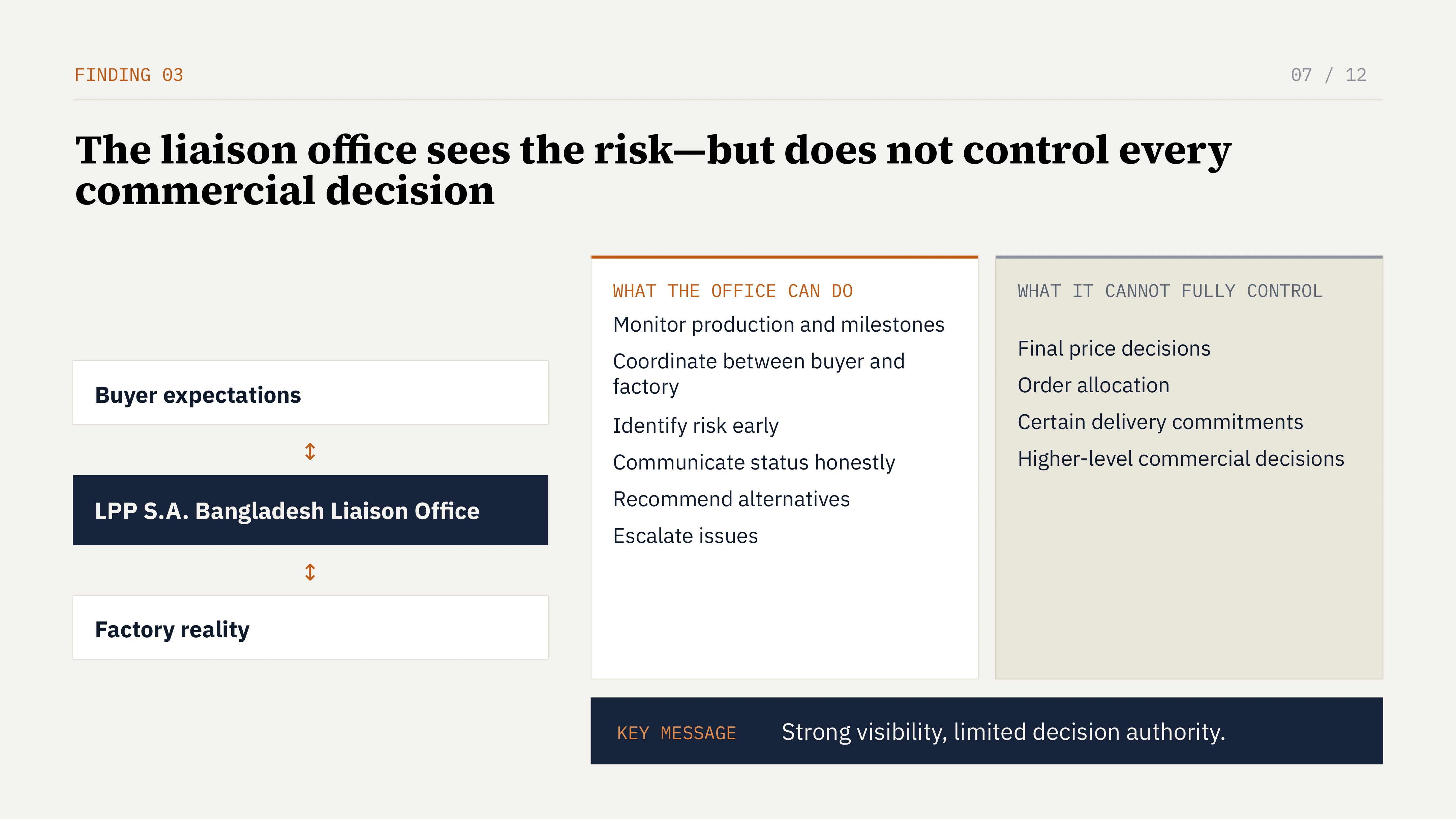
Slide 7 of 12: FINDING 03 07 / 12 The liaison office sees the risk—but does not control every commercial decision WHAT THE OFFICE CAN DO WHAT IT CANNOT FULLY CONTROL Monitor production and milestones Final price decisions Coordinate between buyer and factory Order allocation Buyer expectations Certain delivery commitments Identify risk early Higher-level commercial decisions Communicate status honestly Recommend alternatives LPP S.A. Bangladesh Liaison Office Escalate issues Factory reality Strong visibility, limited decision authority. KEY MESSAGE
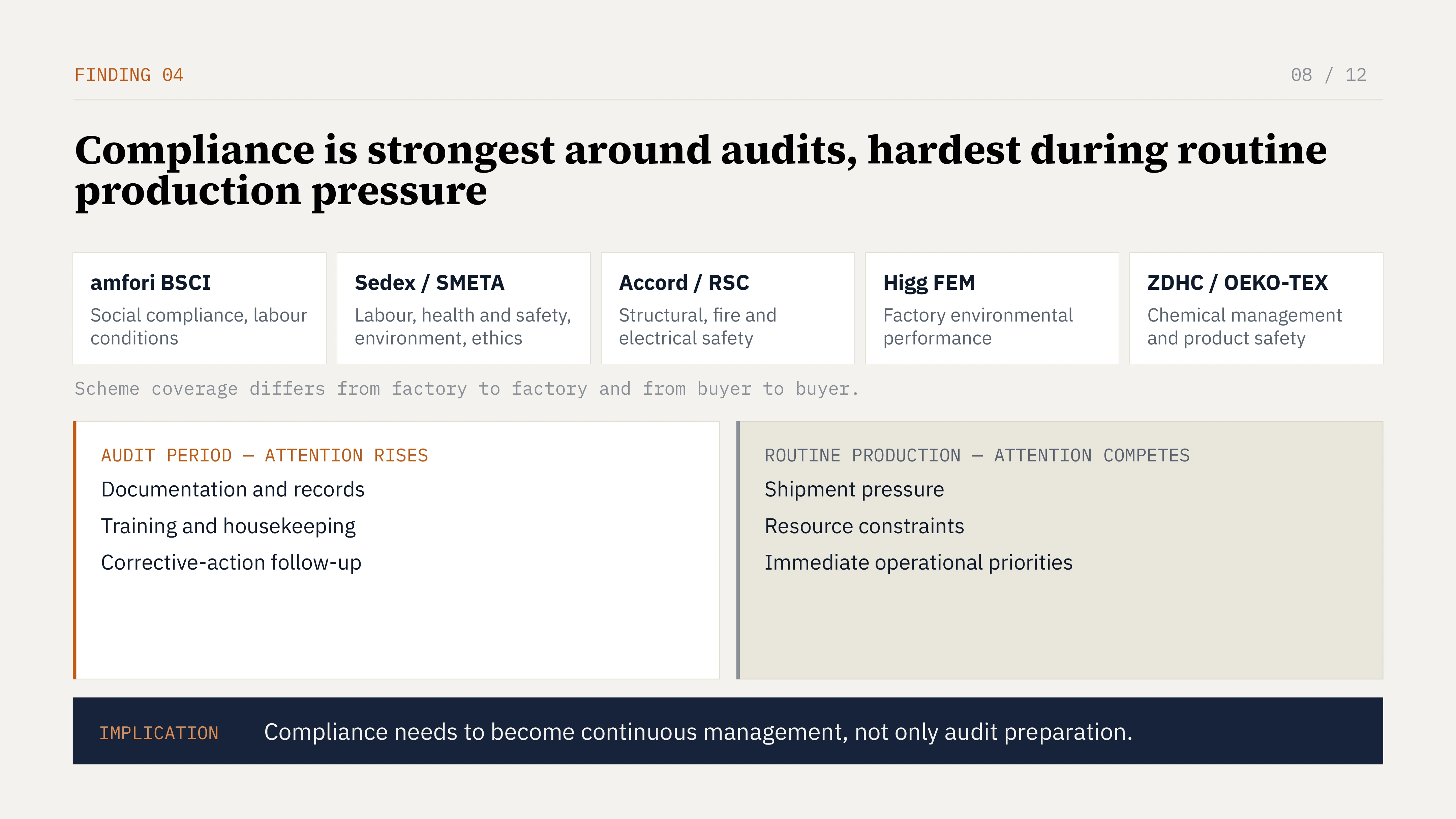
Slide 8 of 12: FINDING 04 08 / 12 Compliance is strongest around audits, hardest during routine production pressure amfori BSCI Sedex / SMETA Accord / RSC Higg FEM ZDHC / OEKO-TEX Social compliance, labour conditions Labour, health and safety, environment, ethics Structural, fire and electrical safety Factory environmental performance Chemical management and product safety Scheme coverage differs from factory to factory and from buyer to buyer. AUDIT PERIOD — ATTENTION RISES ROUTINE PRODUCTION — ATTENTION COMPETES Documentation and records Shipment pressure Training and housekeeping Resource constraints Corrective-action follow-up Immediate operational priorities Compliance needs to become continuous management, not only audit preparation. IMPLICATION
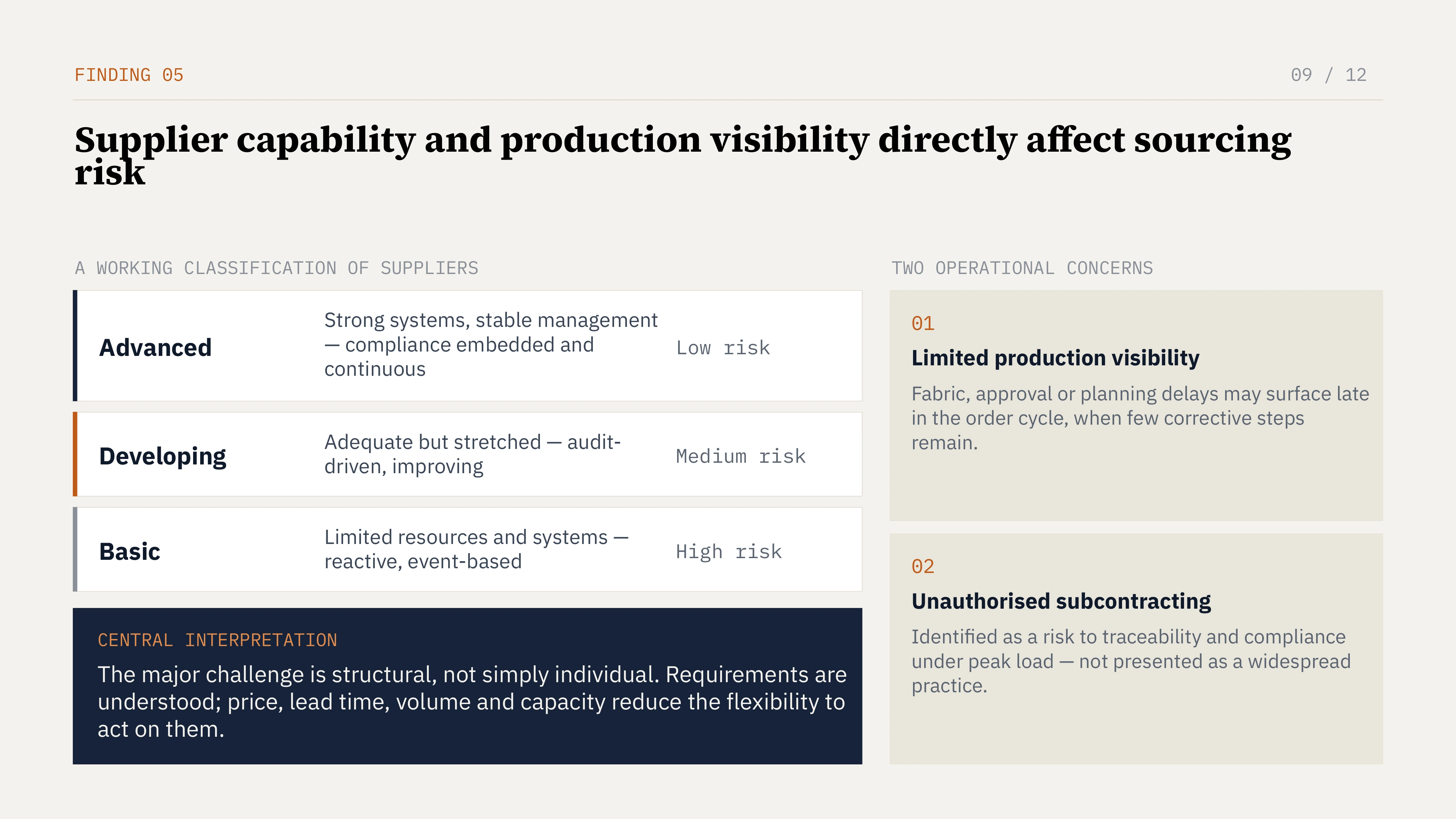
Slide 9 of 12: FINDING 05 09 / 12 Supplier capability and production visibility directly affect sourcing risk A WORKING CLASSIFICATION OF SUPPLIERS TWO OPERATIONAL CONCERNS Strong systems, stable management — compliance embedded and continuous 01 Advanced Low risk Limited production visibility Fabric, approval or planning delays may surface late in the order cycle, when few corrective steps remain. Adequate but stretched — audit-driven, improving Developing Medium risk Limited resources and systems — reactive, event-based Basic High risk 02 Unauthorised subcontracting Identified as a risk to traceability and compliance under peak load — not presented as a widespread practice. CENTRAL INTERPRETATION The major challenge is structural, not simply individual. Requirements are understood; price, lead time, volume and capacity reduce the flexibility to act on them.
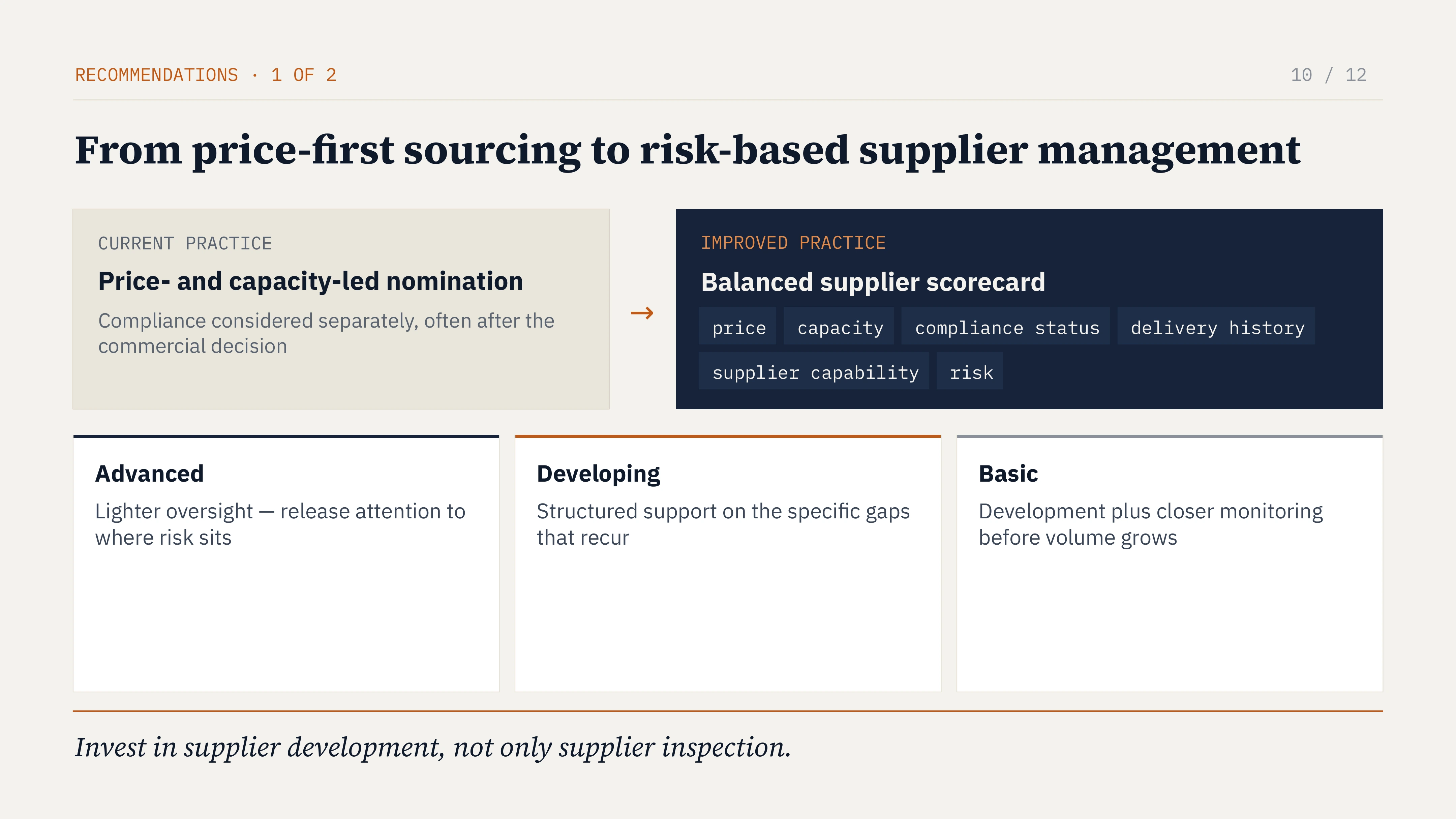
Slide 10 of 12: RECOMMENDATIONS · 1 OF 2 10 / 12 From price-first sourcing to risk-based supplier management → IMPROVED PRACTICE CURRENT PRACTICE Price- and capacity-led nomination Balanced supplier scorecard Compliance considered separately, often after the commercial decision price capacity compliance status delivery history supplier capability risk Advanced Developing Basic Lighter oversight — release attention to where risk sits Structured support on the specific gaps that recur Development plus closer monitoring before volume grows Invest in supplier development, not only supplier inspection.
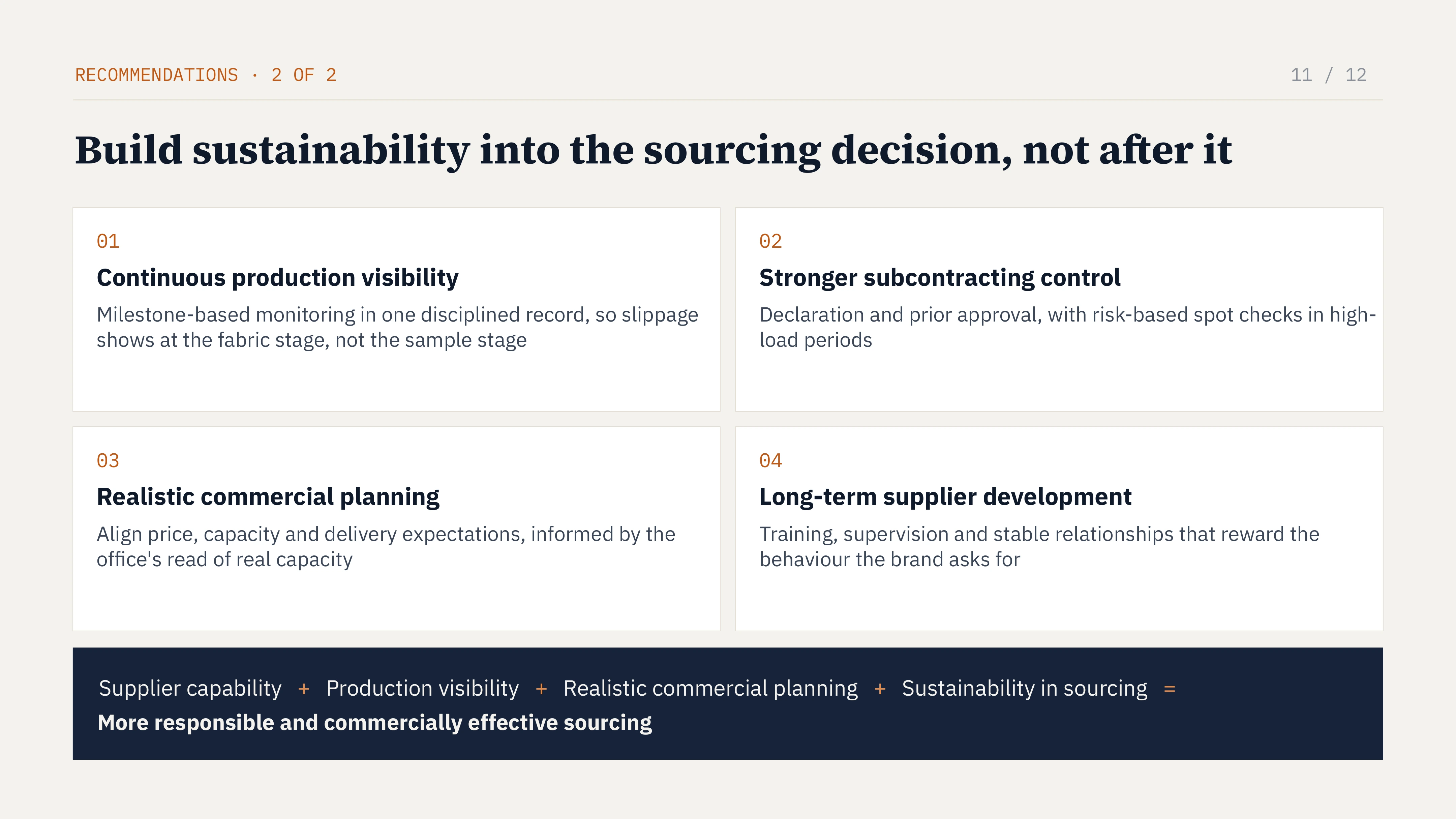
Slide 11 of 12: RECOMMENDATIONS · 2 OF 2 11 / 12 Build sustainability into the sourcing decision, not after it 01 02 Continuous production visibility Stronger subcontracting control Milestone-based monitoring in one disciplined record, so slippage shows at the fabric stage, not the sample stage Declaration and prior approval, with risk-based spot checks in high-load periods 03 04 Realistic commercial planning Long-term supplier development Align price, capacity and delivery expectations, informed by the office's read of real capacity Training, supervision and stable relationships that reward the behaviour the brand asks for Supplier capability + Production visibility + Realistic commercial planning + Sustainability in sourcing = More responsible and commercially effective sourcing
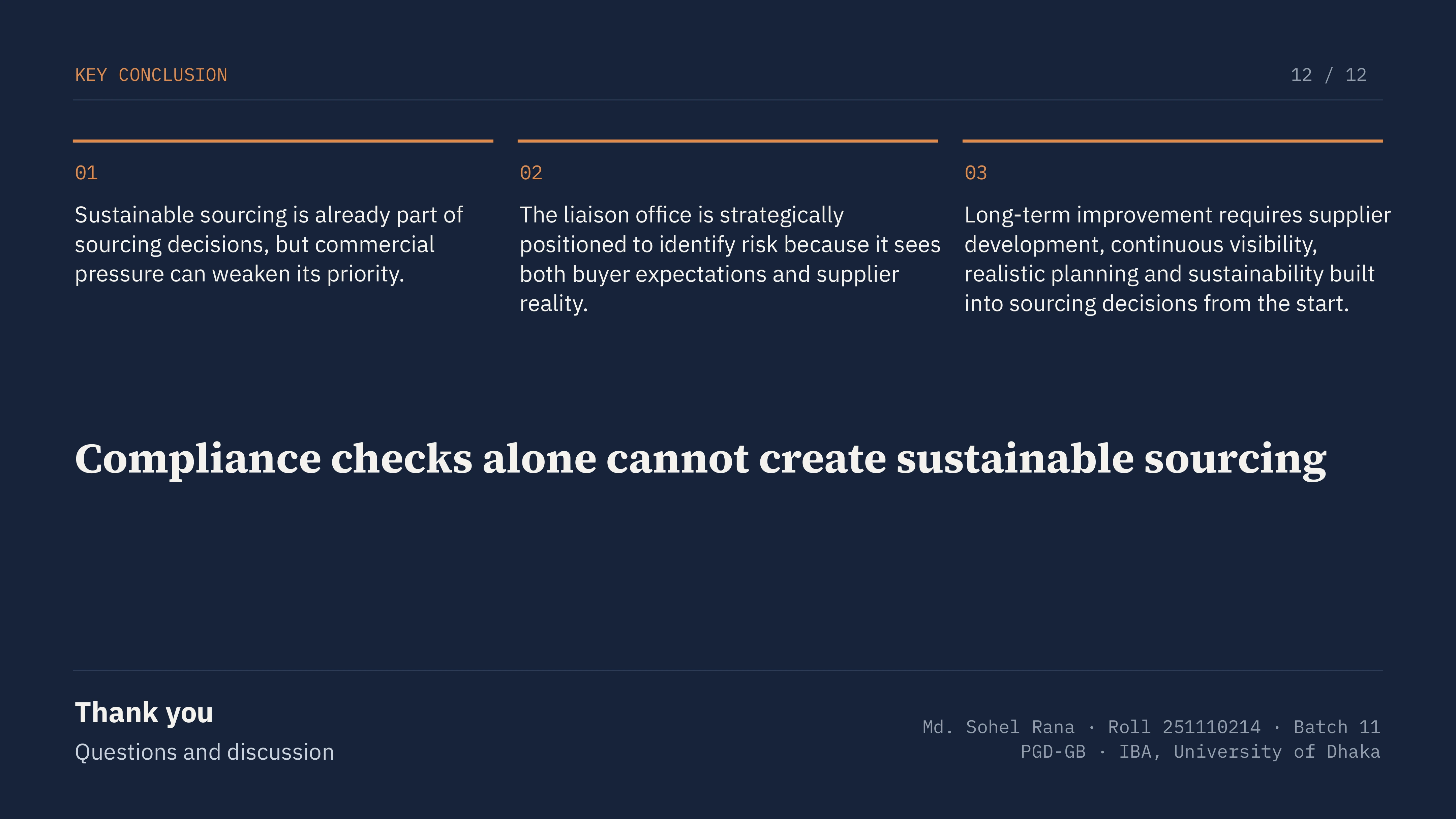
Slide 12 of 12: KEY CONCLUSION 12 / 12 01 02 03 Sustainable sourcing is already part of sourcing decisions, but commercial pressure can weaken its priority. The liaison office is strategically positioned to identify risk because it sees both buyer expectations and supplier reality. Long-term improvement requires supplier development, continuous visibility, realistic planning and sustainability built into sourcing decisions from the start. Compliance checks alone cannot create sustainable sourcing Thank you Md. Sohel Rana · Roll 251110214 · Batch 11 PGD-GB · IBA, University of Dhaka Questions and discussion